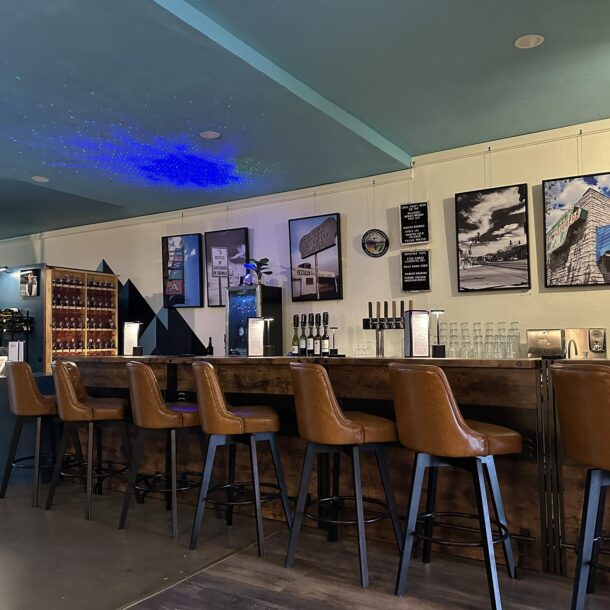
First Thursday, a little after six. Yves has the board set and somebody is tuning in the corner with that particular unhurried patience of a person who has done this in a hundred rooms. Ten or so people in chairs. Somebody’s dog. There are new red velvet curtains hung behind the stage, and I am still not over what they do when the lights hit them.
I have watched this exact scene most months for over three years, and about six months ago I started sitting in it wondering whether I should end it.
The pitch
Open mics get sold to venue owners as the easiest thing you can put on a calendar. You don’t book anyone. You don’t pay a band. The crowd brings the content and you pour drinks.
That is true for a while. Nobody tells you what happens when it stops being true, and nobody writes down what they did about it, so here is ours.
Setting it up
Before we started I talked to Yves Giraud. He had taken over a twice-monthly Sunday afternoon open mic at Mancos Brewing, and neither of us wanted to run the same night twice in one county. Mancos can go outside when the weather cooperates. We are a small room with a low ceiling, so we took Thursday evening and we made it acoustic.
We spent real time on what acoustic meant, which sounds like a small conversation and was not. No electric gear. No backing tracks. And a limit on anything loud enough to swallow a room this size, which we worked out instrument by instrument rather than by rule. A cajon is fine. A cajon has been fine the whole time. What we were protecting was the thing that happens in a small room when a voice does not have to compete with anything, and everybody sitting there gets quiet at the same moment without being asked.
That narrowed the field. It irritated some people. I decided the night belonged to Yves, paid him to run it, and let him hold the line.
The first months worked. Yves called his friends and asked them to show up for something new. People came out of curiosity. The stage was smaller than the one we have now and nobody cared.
The fixes
Then it settled, the way these do, and I started fixing things.
First the drink token. Most open mics give you nothing, and it seemed wrong that a person would stand up in front of a room in my building and get nothing for it.
Then the lottery. We had signed people up first come, first serve, until a night when there were more musicians than minutes. I got an email afterward from someone who had driven a long way in, not gotten a slot, and wanted me to know. It was a fair complaint. Names in a hat from then on.
Then the livestream, on the theory that musicians would want the footage.
Then, about six months ago, fifty dollars for best in show, voted by the audience. I had two things in mind. Audiences drifted out early. Musicians played and left, which bothered me more than I want to admit, because what I wanted was for them to stay in the room for each other.
Every one of those was a reasonable answer to a real problem, and I would make most of those calls again.
Here is what I could not see while I was making them. Every fix was a substitute for the thing that actually keeps people in a room. Fifty dollars was a bribe standing in for a reason to stay until the end. A livestream was reach standing in for an invitation. A lottery was fairness standing in for enough slots. Each one addressed the symptom of a night that had stopped generating its own gravity, and none of them put any gravity back.
The accounting
Musician counts went down. Audience counts went down. Fifty dollars in a thinning room started to feel like money set on fire.
When I finally listed everything I had added, the shape was obvious. A livestream, a lottery, a ballot, a cash prize, drink tokens, a promotion cycle. I had built an elaborate program and I was judging it against the effort budget of a light one, one entirely sensible decision at a time.
The lottery is the one that stings. One person was upset, once, and I changed the rules for everyone. Think about what a lottery means when the event is monthly. You get in your car an hour or more out, drive in, and find out on arrival whether tonight was worth it. If it wasn’t, your next chance is thirty days away. I told myself I was being fair. What I built was a coin flip that people eventually stopped calling.
The part I got wrong about the regulars
For a long stretch I described our open mic to myself as the same people playing the same songs. I said it in a tone.
Tom comes to every single one. He plays harmonica and guitar and most nights he does not play at all. He brings the harmonica anyway, in case somebody up there wants a second line under them. That is the whole reason he is in the building. When a night looks thin I have asked him to take a slot and for a long time he said no, and lately I have talked him into it a few times. One of those nights the room voted him the fifty dollars.
They are not a symptom of anything. Twelve first Thursdays a year means a person playing their same three songs is playing them twelve times, not fifty-two, and I am the only one in the building who has heard all of it. What felt to me like a rut probably reads to a stranger walking in as a room with a house band, which is not the worst thing to be.
I was also annoyed that people left after their sets. That is a room I designed. There was no reason to stay, and rather than build one I tried to buy one for fifty dollars.
What we changed
We are subtracting instead of adding.
The fifty dollar prize is done.
There is a sign-up page now and it is simply always open. Put your name down whenever you think of it, and your slot is confirmed before you get in the car. Two spots stay open for anyone who turns up not knowing there was a page, because a first-timer should not get turned away over a rule they had no way of hearing about. The lottery is over.
I am announcing all of it from the venue side, because signup mechanics should not be one more thing Yves carries while he is running sound and hosting.
The livestream stays. It is the one addition that costs almost nothing to keep and leaves something behind. Two years of first Thursdays are sitting on YouTube, and every so often a musician sends that link to somebody.
That is it. Yves, a sign-up, a drink token, a camera, and a room.
Ask me in November
I do not know if this works.
It is possible the change brings back people who quietly stopped coming. It is also possible that in a town this size, the number of people who want to play acoustic in front of strangers on a Thursday is about the number of people already doing it.
If that is the answer, I think I am fine with it. Ten familiar people on a first Thursday is a functioning small-town ritual, not a failure. I spent a while treating it as a problem because it was not growing, which says more about how I was measuring than about the night.
First Thursday, six o’clock. The red velvet will be catching the lights, Yves will be at the board, and Tom will be somewhere near the back with a harmonica in his bag.
Acoustic Open Mic w/Yves happens first Thursdays, 6pm to 8pm, at ZU Gallery, 48 W Main Street, Cortez. Sign up here.