Why every event in this county is fishing in the same small pond
Maybe you’ve been to a show in town with 20 people in the room. Great band, good night, and you wondered where everybody was. A month later the same band plays the same place and you can’t find a seat.
It’s easy to take the quiet night as a sign that the band, the venue or the whole local scene is struggling. Most of the time I don’t think that’s what’s going on.
I think there are about 500 people in Montezuma County who have the money, the time and the habit to go out to events. Those are the people who actually come, and every venue, fundraiser, gallery opening and concert in the county is drawing from that same group.
My own numbers point the same way. In September, 69% of the people who paid by card at The ZU had been in before. Cash and shared tabs don’t get counted, so it isn’t perfect, but most of any room I fill is people who already know where I am. I’d bet most venues in town would tell you the same thing.
How 26,800 people becomes 500
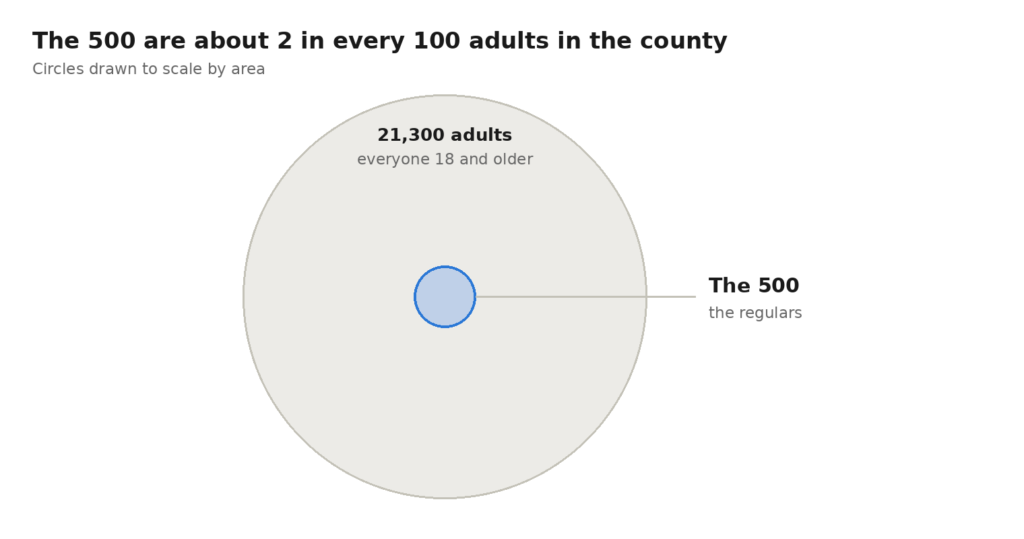
About 26,800 people live in this county. Take out the 5,500 kids and you’re at roughly 21,300 adults. Two out of three of them live outside Cortez, Dolores and Mancos, and a half-hour drive each way on a weeknight is a lot to ask.
Money cuts it further. Median household income here is about a third below the state’s, and around 3,400 people live in poverty. A cover charge and a glass of wine is a real line in a lot of budgets. Then there’s time: two jobs, night shifts, ranch hours, little kids, a parent who needs care. A quarter of the county is 65 or older, and plenty of them would love to come out but don’t drive after dark. And some people just like being home.
The kids, distance, money and age numbers come from the census. The rest is five years of watching who walks through my door. When I add it all up I get about 500 people, or about 2 out of every 100 adults.
The core and the ring
Around those 500 is a bigger group who come out once or twice a year for the big or one-time stuff.
That’s where new regulars come from. Somebody comes to one big night, has a good time, and comes back, and then comes back again. I don’t think growing the arts here means finding strangers. It means getting those once-a-year people to come more often.
Visitors fill some rooms too, but they leave with the seasons. The 500 are who’s still here in February.
Then the 500 gets split
Five hundred is the most you could hope for, on a night with nothing else going on. That night almost never happens.
Three good events in three towns on the same Saturday are splitting the same people three ways, and nobody did anything wrong. Politics splits it too. In a county this small people know where their neighbors stand, and when a local issue heats up, some folks quietly stop going places where they’ll run into the other side. Then there’s regular life. Someone’s sick, someone’s mom is in the hospital, someone’s avoiding an ex. Out of 500 people, a few of those are true every week.
So on any given night, a lot fewer than 500 are actually free. A room of 40 might be a good share of everyone who could have come.
If you put on events
I’m one of you. I’ve had the 10-person nights, and like everyone I’ve blamed myself. Wrong night, wrong price, should have posted more. I’ve also probably booked on top of someone else’s event without knowing it. Here’s what I’m trying at The ZU.
I try to do things nobody else is doing. We’re not really competing with each other so much as hosting the same few hundred people. When three places run the same kind of night, those people spread out and nobody’s room fills. I’d rather this county have ten different nights out than the same one ten times.
I’ve met with the people who organize events at The ZU to make sure we aren’t layering too many events at once. Spacing things out is a lot easier than a half-empty room.
I try to get people back after their first visit, while the good night is still fresh. Getting an email and sending a personal invite to the next thing goes a long way.
And I try to make it easier to come. The ZU is known for its 6pm dance parties, which work for people who don’t want to be out late or drive home in the dark. I also do free nights when I can afford them and afternoon events. Not every venue can do all of that, and I can’t do all of it either. But anything one of us does to make it easier helps everyone.
If you’re one of the 500
In a city, one more person in the audience doesn’t change much. Here it does. If the whole group is 500 people, you’re a real part of every room you walk into. Your impact gets bigger because the numbers are small.
Ten people deciding to come out on a slow Thursday can turn a quiet night into a good one. That can decide whether a band books Cortez again on their next tour, or whether a new series makes it past two months.
A few things help more than people realize:
- Early tickets and RSVPs. That’s how organizers decide staffing, food and pay.
- An invite from a friend. Someone who only comes out for the big nights is much more likely to come because a friend asked than because of a flyer.
- Showing up for the small stuff, like the first night of a new series, the open mic, or an artist nobody’s heard of yet. That’s where the next favorite night gets its start.
- Word of mouth. When people hear about a great night the next day, more of them come to the next one.
Nights out are also one of the few places left where people who’d never agree on a ballot still end up in the same room.
Thank you. A lot of the arts in this county run on your evenings and your wallet, and we notice every time you show up.
So the next time you’re deciding whether to go out, remember the math. You’re not one in a crowd. You’re one in only 500.