It started with an email.
On December 20th, 2025, Mark Stevens sent a note to the ZU asking if we might be interested in having Midnight Cowboy come play. Casual, friendly, no pressure. He mentioned the band plays music by The Velvet Underground and a few similar artists, that they have a low-key acoustic setup, and that he thought it might work well at the ZU.
I knew Mark as an author. He has an impressive collection of his books for sale at the ZU, and he helps run the Four Corners Writers Group, which meets here every third Wednesday and offers free workshops in our space. A writer. A community builder. That’s who I knew.
What I didn’t know was what else he was capable of.
I wrote back the same day. I told him I was putting together the March calendar and would love to explore it, but that I’m always looking for ways to make our events distinctive and memorable. Something that stands out from a typical concert experience. I asked him what might make a Midnight Cowboy performance at the ZU feel special.
What came back changed everything.
A week later, Mark wrote with two ideas. One involved bringing art supplies and creating pieces during the band’s longer songs, some of which run five, six, seven minutes. The other was the one that stuck. He described how when the Velvet Underground played Andy Warhol’s Factory loft, Andy would project movies onto the band. No sound from the films. Just flickering images, actors auditioning, New York street scenes, experimental footage, washing over the musicians in real time. Mark thought if they hung a sheet behind the band, they could do something similar. Shoot video around Mancos and Cortez, cut it together, project it on the band. “Well, SAME is a stretch!” he wrote. But he liked the idea.
I loved it. We confirmed March 14th, a cover charge to help offset costs, and our newly purchased oversized screen, the same one we had just bought for our Chaplin night.
People sometimes ask why every event has to be a concept. Why can’t a musician just show up and play?
They can. And sometimes that’s exactly right. But I’ve learned something from four years of doing this in a small town. I wrote about it in a previous post – we live rurally, our choices are limited, and people love their local restaurants but can grow tired of the same thing every week. The same is true for live music. What keeps people coming back, what gets new faces through the door, is the feeling that they might see something they will never see again. One of a kind. That’s what fills a room in Cortez on a Saturday night.
Mark’s email gave me that.
That was January 5th. The show was March 14th. Between those two dates, Mark Stevens built a two-hour film at no additional cost to the ZU, because he believed in the idea and wanted to see it realized. The Monday before the show, while we were closed, he came in to test the video on the big screen so there would be no surprises on the night. I was under the weather, but knew it was important to make it happen. We got it done.
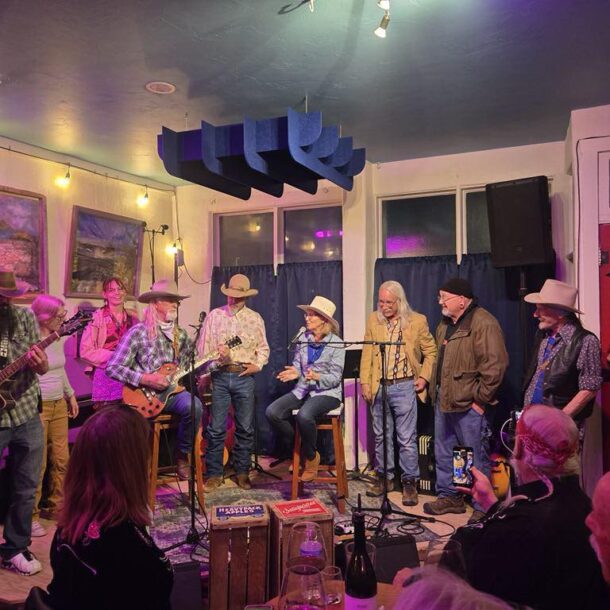
What the audience saw was two hours of locally-shot footage, colorized and sequenced, opening with a creative turntable shot and moving through familiar drives and local landscapes, all cut to breathe with the music. What it took to make that was something else entirely. The music started long before anyone walked through our door. VIDEO
Here’s something else you might not know about Midnight Cowboy. The band was born out of two musicians’ shared love of the Velvet Underground and a moment when Mark complimented a guitar player on his bluegrass band. That was the spark. Carlton Harwood, Bill Cuskelly, Erin Faehling, Mo Murray, and Mark Stevens practice together in a garage in Mancos. I know this because Hagen gave me a hug on his way in Saturday night and mentioned that he and Nancy host the band there. A community holding a band so a band can hold a community.
Saturday was the first time I saw Mark in this new capacity. Author, community organizer, filmmaker, bassist. It was something.
To put on a night like The Factory Sessions, there’s a band to pay, a doorman, Facebook ads, Abboe Sound managing a five-piece for the first time with multiple singers, multiple guitars, fiddle, flute, and a full drum kit in a reconfigured stage layout, and Alysha Rivera behind the camera. We pay our photographer because documenting these nights well is part of how we tell our story. Alysha was shooting in some of the most challenging light we have ever had in this space, slow color strobes and projected film, and she delivered. We also offer hospitality to our performers and crew, because that feels like the right thing to do.
We didn’t sell tickets in advance. We had no idea how many people might walk through the door and pay the $5 cover. That’s just part of how we operate. Some nights you pack the room and some nights you don’t, and you build the event the same way either way.
I’m not writing this to complain or to ask for anything. Saturday night was exactly the kind of night I opened the ZU to create. Great crowd, new faces, a vibe that made people want to stay.
And when you see a free event on our calendar, that just means we are absorbing all of it. Musicians are still getting paid.
Even when a band doesn’t have a tip jar on stage, you can still tip. Find them afterward. It means more than you know.
Every musician paid, every photographer hired, every sound engineer booked keeps creative dollars in Montezuma County. That’s the whole point. And nights like this one are proof that when a community invests in its artists, the artists invest right back.