My mom is a photographer. Weddings, portraits, all of it. And from pretty early on, I was her shadow. I’d go with her to classes and watch how she moved around people, how she waited for the right moment, how she made strangers comfortable enough to forget she was there. At some of her weddings she’d hand me a second camera and let me just wander. No direction, no pressure. Just go find something worth looking at.
I didn’t know I was being taught anything. I thought I was just tagging along. But something was getting in, the way things do when you’re a kid and you’re paying attention without realizing it.
I didn’t pick it up seriously myself until my late twenties. I was a military spouse by then and trying to figure out what I could do that would travel with me, something that was mine no matter where we landed. I bought my first Nikon because that’s what my mom used, obviously. And I started the way any sensible person starts: photographing my own hand. Every setting, every combination, every weird result. The internet was not the endless tutorial resource it is today. Learning by doing was my teacher. That and my mom, who I sent photo after photo to like she was my personal editor. She’d tell me exactly what wasn’t working and how to fix it. I’d also spend hours looking at other people’s photography, just trying to understand what drew me to certain shots and how they pulled it off.
I called the business Wild Blue Bug Photography. Wild Blue from the Air Force song, Bug for shutterbug. My people were other military spouses because they got it. They understood why I was doing this and they were kind enough to let me practice on them. I started with free sessions and eventually worked up to a $25 sitting fee once I trusted myself a little more.
Landscapes were never my thing. I was always drawn to people. Not just to how they looked but to their stories, and once I learned what those were, I wanted to figure out how to make the photo say something true about them. The hardest part was when I felt like I’d done that and they didn’t like what they saw. People don’t always want to be seen clearly. That’s a big part of why photo filters are so popular now. People want to be perceived how they wish to be, not how they actually are. Which is its own kind of beautiful. But it’s not the work I love most.
When my marriage ended I needed to move the business beyond the military community I was no longer connected to. I call it my barista era now. I had a coffee shop job in Baltimore City and I was pushing my photography on the side to earn extra money. And then I found Creative Exposure, Baltimore’s photography club, and I found my people. I was going through a divorce, I was hundreds of miles from my mom, and I walked into a room full of people who cared about exactly what I cared about. They became my safe space. We dove deep into street and portrait work together and somewhere in all of that I started booking corporate clients. That first one was pure validation. It showed me I could actually make a career of this. I brought on an assistant. Things were moving.
And then I compromised my trajectory. A new relationship moved me to Colorado and I put the camera down. Not forever, but it felt that way for a while. I had finally gotten somewhere with it and then I set it aside for someone else’s life. I have regrets about that. I also wouldn’t be here without it, so I hold both of those things at the same time.
Photography went back to being a hobby. I landed in a tiny mountain town near Vail called Minturn, population 1,200, and it was my first real taste of small town life. I ended up running their community fund, doing events, mutual aid, all of it. Nobody handed me a roadmap. It just came naturally. And somewhere in the middle of all of it I realized that this was the kind of work I was made for. Looking back it’s almost funny how directly it connects to what ZU Gallery has become. I just didn’t know that yet.
That’s also where the website and marketing work started. HTML from school, Photoshop from photography, and suddenly I was building websites and doing graphics for organizations that needed someone who could figure things out. The nonprofit world made sense to me in a way a lot of things hadn’t. Years of helping military families had quietly been training me for it the whole time.
Eventually I made my way further southwest. I spent a summer running a photography studio in downtown Durango. Hard work, a lot of fun, just not quite my speed. I moved to Dolores in 2018 and for the first time in a long time I felt like I was back in my own current. I had been riding someone else’s wave for years and I hadn’t even realized how far it had taken me from myself until I stopped. Relaunching the business wasn’t just exciting. It was like exhaling. I was so ready to get back to me. Starting over in a small town where nobody knows you is its own kind of challenge and I’ve had that conversation with a lot of people since. You just keep showing up and you keep the work good and eventually the town starts to feel like yours. Things were finding their rhythm. And then they weren’t.
January 25, 2020. The day after a photo booth event my mom and I worked together, I had a stroke.
I remember being in the hospital and realizing my vision had changed significantly. I couldn’t walk at the time. My first thought was not abstract. It was: my photography career is over.
Fast forward through a year I won’t fully get into here. I had breakfast at Pippo’s with my lifelong friend Scotty and on the walk back I noticed a for rent sign in the window of the old Havran dry cleaners on Main Street. I thought it was just the front space and my mind immediately went to photography studio. That one window got something going in me. The next day I picked up my camera to find out if I still could.
I had to adapt. My right trigger finger couldn’t feel the button anymore so I learned to grip with my right and push with my left. It looks a little awkward. I never think about it now. My eyesight had blurred but corrective lenses helped with that. So I went out and I shot.
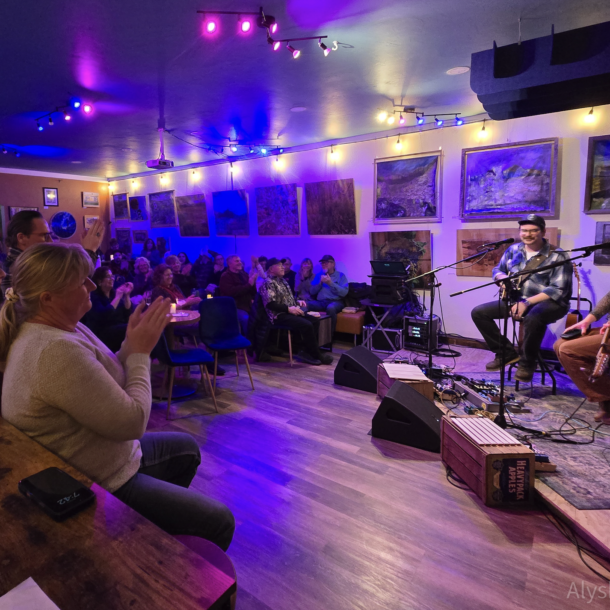
The large canvas prints here at the ZU are from that first day. Not my best work by a long shot. But they hang there on purpose. Every time I look at them I remember how I started again.
In the early days of the ZU, while I was still healing, my mom Chris stepped in and took on portrait sessions so the studio could keep going. She’s still here. We team up on photo assignments all the time. She’s the primary shooter at our photo booths while I handle edits and production behind the scenes. The woman who handed me a camera at weddings when I was a kid is still handing things off to me. I don’t take that lightly.
These days I work exclusively in the studio, with the occasional off-site event when Chris can join me. My physical limitations are real and I’ve made peace with working around them. What hasn’t changed is the work itself. Sessions here are informal by design because comfort is how you get a real photo. I’ve kept my prices reasonable because this corner of Colorado deserves access to that. And nearly twenty years in, I still get a little excited every time someone new sits down in front of my lens. I never know whose story I’m about to learn. That part hasn’t gotten old and I hope it never does.
Some of the people who’ve sat in that chair are regulars at the ZU now. They walk past those first day canvases every week and have no idea what they’re looking at. That’s okay. I know.
Jodi's photographer's journal Proof of Light releases May 2026 - a guided companion for new and seasoned photographers to document their own journey through prompts, journaling, and production notes. To book a portrait session in the ZU Gallery studio in Cortez, Colorado, visit zugallery.com/calendars.